
Chicken Road (Cross the Road) on CrazyBet: review, strategy and RTP after 2,000 rounds
We ran 2,000 rounds on Chicken Road across all four modes, full P&L on the table. Honest review, real strategy, and the mental trap that costs you your winnings every time.


What is Chicken Road?
On CrazyBet, the game appears under the name Cross the Road, though plenty of people know it as Chicken Road. Same title. Same InOut Games release.
The setup takes one line. You guide a chicken across the road, tile by tile. Each tile crossed pushes the multiplier higher, and you can cash out whenever you want. If a car hits the chicken before you bank it, the round is gone.
Simple idea. Works better than it should.
| Game | Cross the Road (alias Chicken Road) |
|---|---|
| Provider | InOut Games |
| Type | Crash game / cash-out road crossing |
| Risk modes | Low, Medium, Hard, Hardcore |
| Minimum stake | $0.01 in real money |
| RTP | 99%, amongst the highest in this category |
| Max multiplier | x3,203,384.8, subject to payout cap |
| Fairness | Provably Fair, verifiable seeds |
| Mobile | Yes, on mobile as well as desktop |
How do you play Chicken Road?
You choose your stake and risk level, then the chicken faces a line of manhole covers. Each cover shows its multiplier before you jump, so you know the potential return before committing.
That matters. You are not clicking blind. You can push one more tile, take the cash-out, or accept that the next jump might wipe the round.
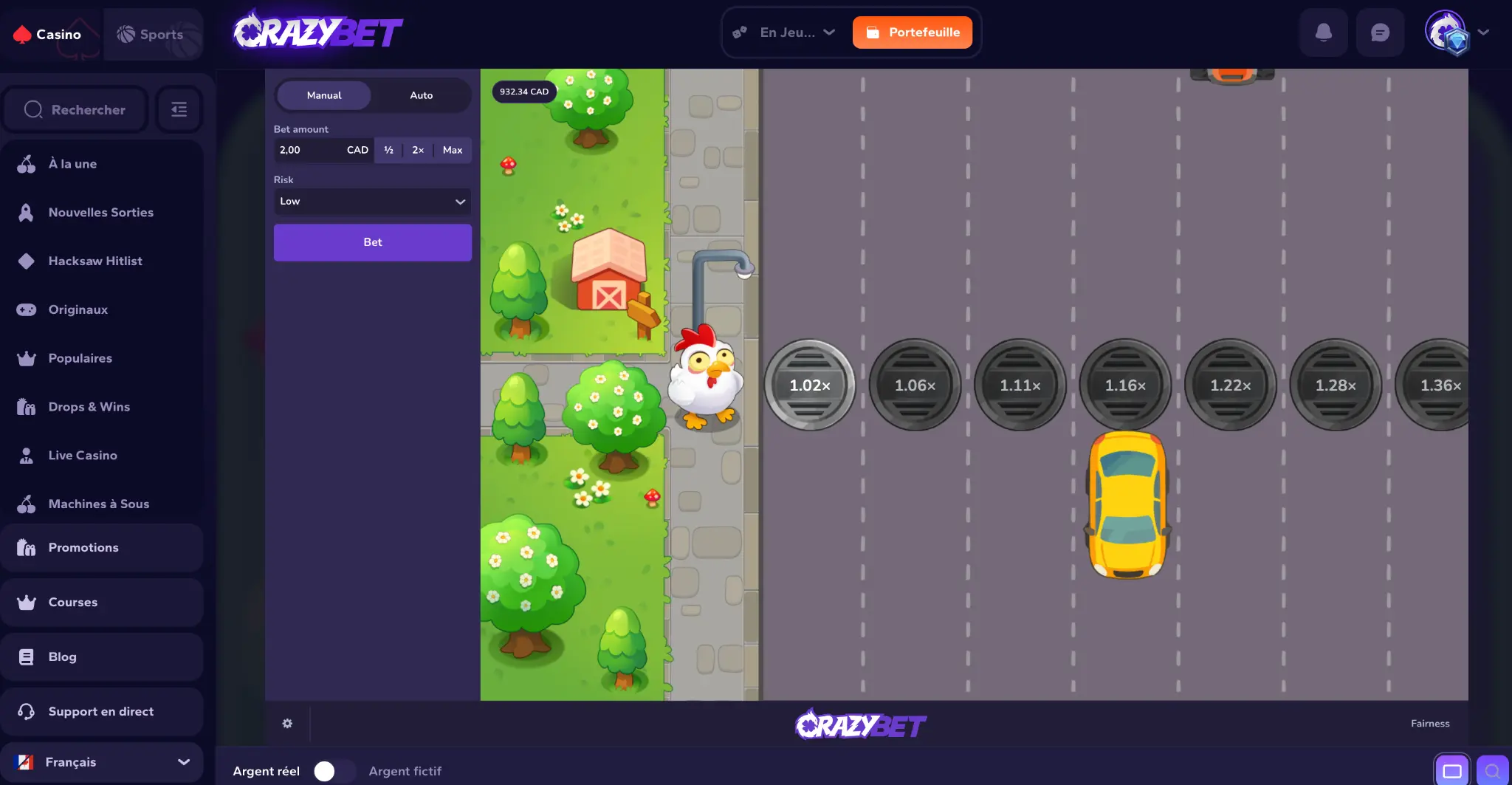
To move forward, you either click Jump or hit the next cover directly. Each successful step lifts the multiplier, then you decide. Cashout to take what you have built, or carry on and aim higher.
Every jump runs on RNG. If a car comes through the lane at the wrong time, the round stops there and the stake is gone.
Auto mode sits alongside it. You set the number of steps before automatic cashout, run batches of rounds without clicking each time, and add stop points for profit or loss.
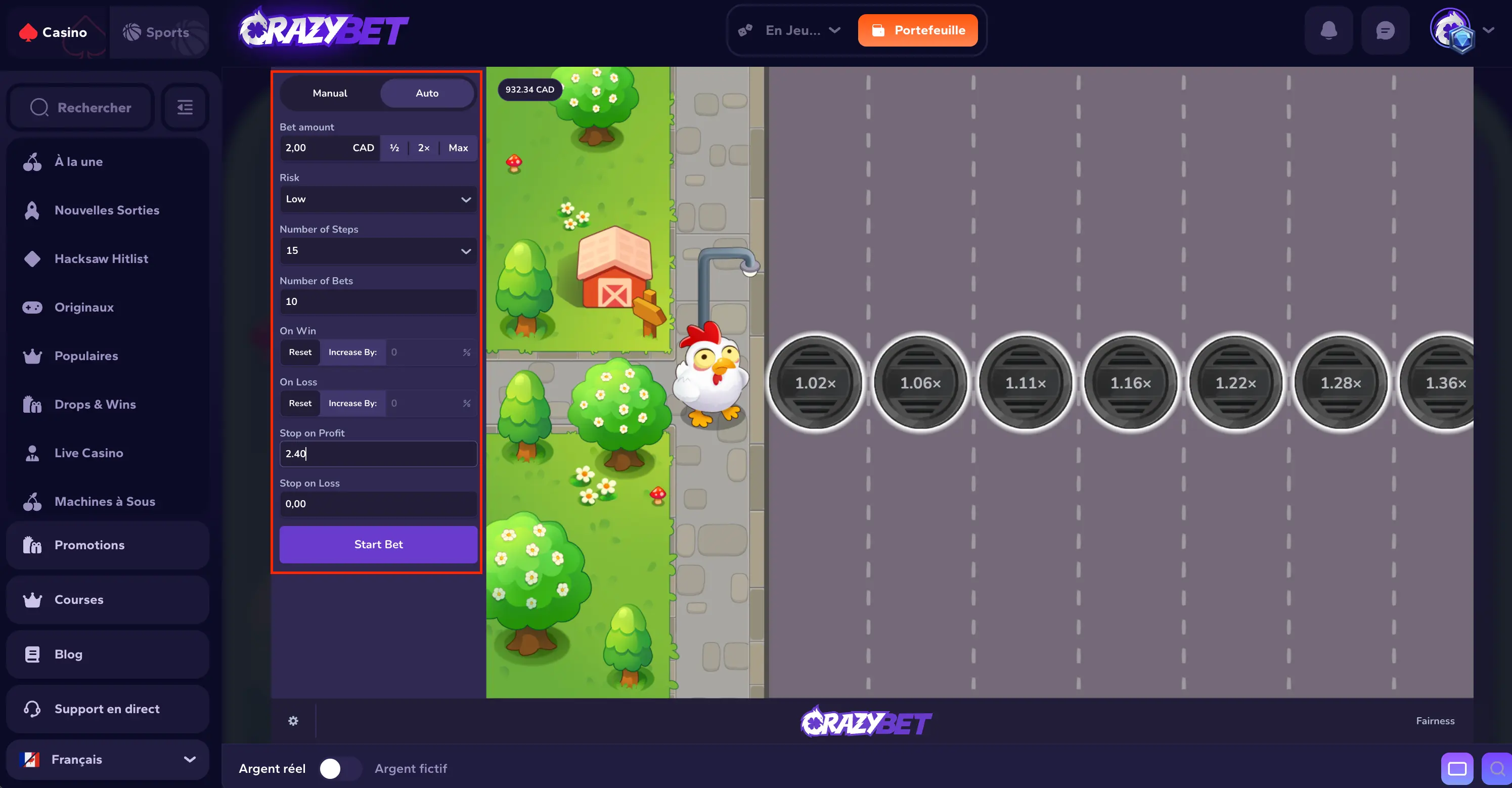
You can try Chicken Road for free before putting your bankroll in. CrazyBet has a play money mode in the bottom-left corner of the game screen. Useful enough for getting the cashout rhythm right without spending a cent, then switching to real money when you are ready.
The 4 risk modes in Chicken Road
You get four options: Low, Medium, Hard and Hardcore. Push the risk higher and there are fewer covers to cross, but the multiplier climbs faster.
That trade-off is the whole game. A shorter road looks cleaner, but each step carries more danger. One bad jump and the round is finished.
| Mode | Covers | Profile |
|---|---|---|
| Low | 24 | Gentle climb, smaller gains |
| Medium | 22 | Risk / reward compromise |
| Hard | 20 | Higher multipliers |
| Hardcore | 15 | All-or-nothing within a few jumps |
In Low, the first step pays 1.02x, then 1.06x, 1.11x, 1.16x. Cashing out after the first step for a 2% return makes no real sense. This mode is played cover by cover, and the multipliers only start to move properly once you get close to the far pavement.
Hard flips that around. We saw covers at 413x, 929x, 2,479x, 8,677x, then 52,067x, but reaching those numbers is more of a feat than a plan.
The key point is simple: the RTP does not drop when you move up the risk ladder. The house edge stays the same. What changes is variance.
In Low, your return tracks the RTP fairly quickly because the wins come in more regularly.
In Hardcore, the return is buried inside rare, heavy hits. Across a few hundred rounds, you can land miles below RTP, not because the game pays less, but because you have not hit the big result that drags the average back into line.
Our Chicken Road session: 2,000 rounds
2,000+ rounds went in, 500 on each mode, with stakes between $0.10 and $5. Basic rule: the more volatile the mode, the lower the stake. Dry result, around $1,250 wagered for $1,238 returned, so a $12 loss.
Our best hit was x2,479.40 on a $0.25 stake in Hard mode, close to $620 from a single round. We managed to grab the screen just before the hit.
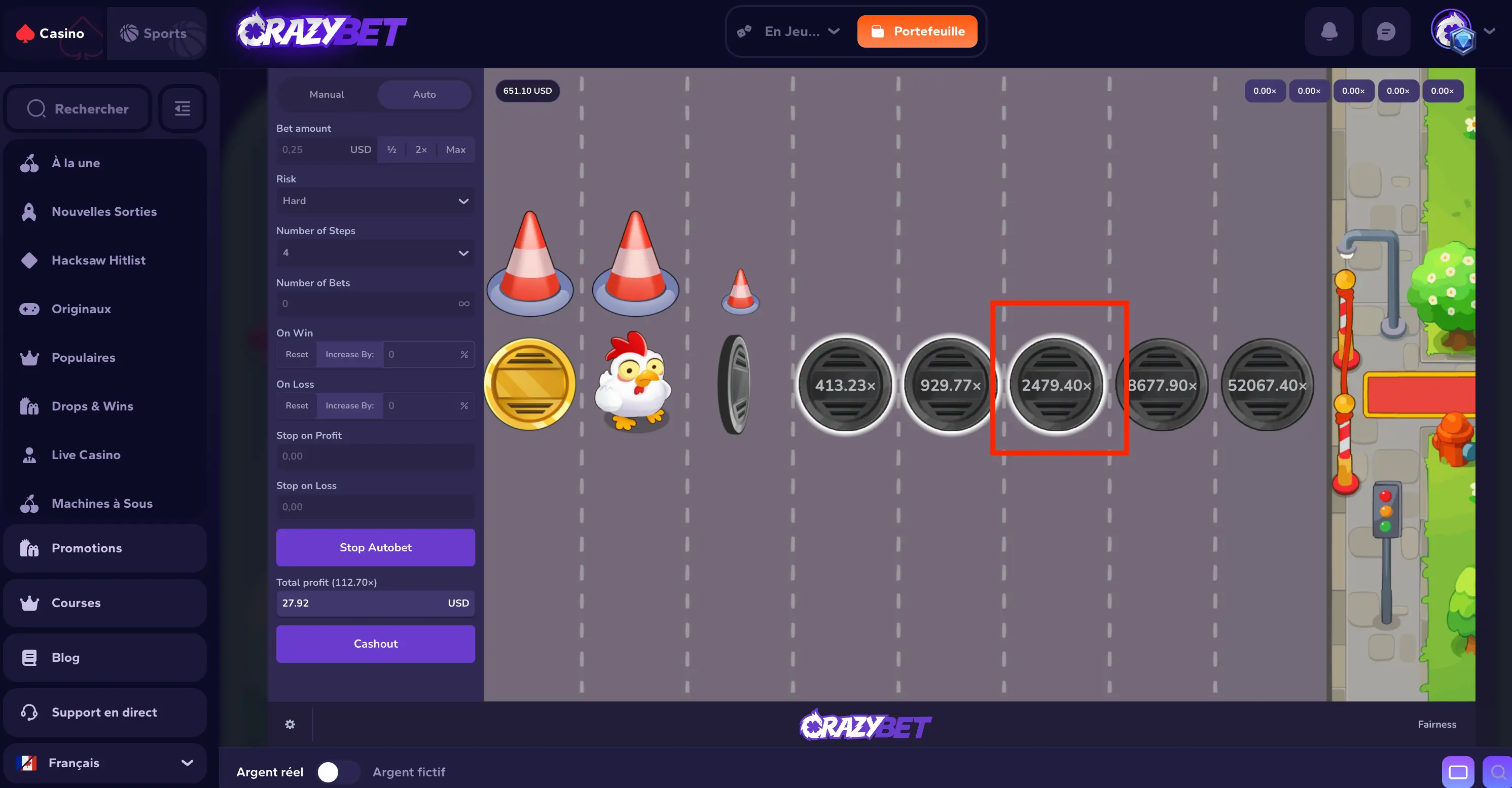
Two or three hits like that pulled back most of what the extreme modes had taken.
The field read after 2,000 rounds is three things. Cars appearing out of nowhere and flattening the chicken right when you stop expecting it. Turbo mode moving so fast you stop tracking what is actually happening on screen. That exact second where you convince yourself one more lane is safe.
Mode does not matter much in the end. You lose. We checked it. We could chain nine or ten cashouts at x1.75, but three losses in a row and one small win were enough for the house to quietly take back what it had given.
That is how our balance faded. No dramatic crash. Just a slow bleed. A 99% RTP slows the fall down, it does not remove it.
Chicken Road strategy: can you actually win?
No trick beats the RTP. No system either. Over time, the house keeps its edge.
What your play style changes is how long you stay alive. You can stretch the same starting balance for hours, or burn through it in fifteen minutes.
Set your target and stick to it
The real trap in this game has nothing to do with bad luck. It sits in your head.
You set a target, say x4. You reach it. Instead of cashing out, you see the bigger number sitting one tile ahead and tell yourself it is only one more step. You continue. You lose the lot.
That happened to us more times than we care to count. The only reflex that protects your balance is boring: if you decide to cash out at x4, you cash out at x4. Leaving the plan as soon as you see a bigger number is the cleanest way to give the game back what it just paid.
Low or Hardcore: which mode fits which player?
We do not use every mode the same way, and that is where session length is decided. In Low, we staked higher but aimed small, between x1.5 and x1.7.
Not x2. At that point, you may as well play blackjack. The idea was to build the balance in steps, three or four cashouts in a row, then walk away with a small profit.
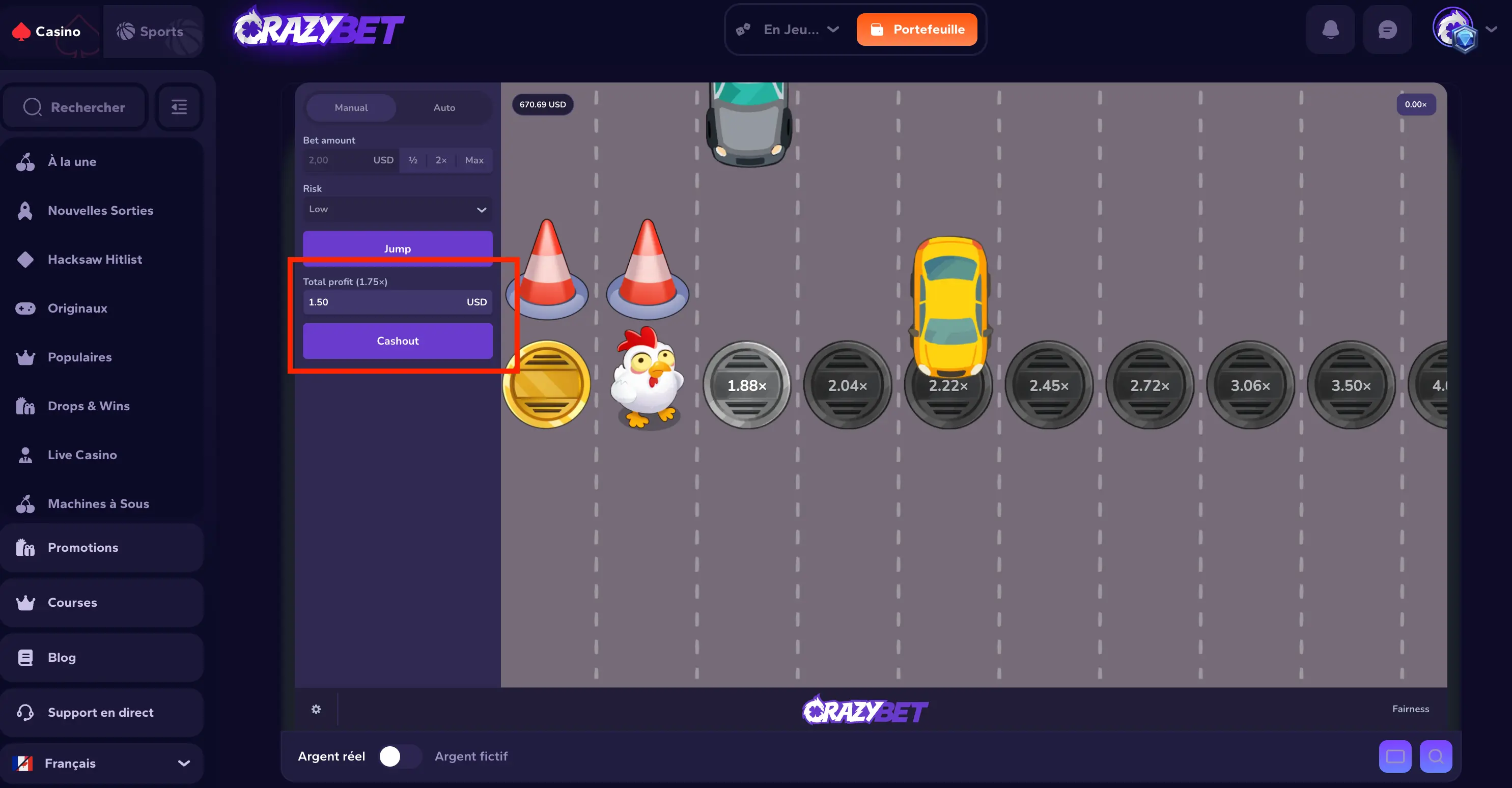
We rolled that profit into very high volatility with tiny stakes. In practice, $12 of margin went into Hardcore at $0.10 a round to chase x1,000. In Hard, we hunted x3,000. In Medium, x10.
Never the other way round. Dropping $5 on Hardcore while aiming for x1,000 makes no sense, you can burn the balance in a handful of rounds. The stake comes down when the target goes up.
Do not tilt either. In Low or Medium, you can take ten or twelve losses while chasing a decent multiplier, but a bad run is statistically shorter in Low than in Hard or Hardcore because the variance is compressed and the return towards RTP is faster.
Hard and Hardcore are the trap. Telling yourself “it has been a thousand rounds without a proper hit, it has to land soon” is the worst possible approach. You can miss for tens of thousands more rounds. Your chances of reaching x2 in Low are not remotely the same as landing x3,000 in Hard.
Auto mode and martingale: the illusion explained
Auto mode served one purpose for us: not restarting every round by hand. You set the cover where you want to stop, the chicken either gets there or gets flattened before it, and if the target cover lands, the cashout happens automatically. Useful. Nothing more.
The line we would not cross is martingale, and the game tempts you with the “On Loss Increase By %” option, which raises your stake after every loss. We never use it. On paper, it looks unbeatable, because nobody expects to lose ten rounds in a row.
On RNG, raising your stake after a loss does nothing to the expectation. You only change the size of your swings and the speed at which you can lose everything.
It looks unbeatable until a losing streak, which will arrive sooner or later, wipes out everything you built and then some. In a casino, the impossible turns up eventually. We have lived it, so believe us.
Chicken Road RTP and max win: what they do not tell you
Everywhere, you see the x3,203,384.8 max multiplier being pushed. Looks huge. The official rules also set a per-round payout cap of $1,162,838.66, and the game automatically cashes out your chicken once continuing would go beyond that cap.
Do the maths: $1,162,838.66 divided by x3,203,384.8 gives 0.36. That famous x3.2 million is only reachable if you stake $0.36 or less. Above that, the cap cuts you off first.
- At a $0.10 stake, you can theoretically chase x3.2 million, with the payout capped at $320,000
- At a $1 stake, your real ceiling drops to around x1,162,838
- At a $100 stake, your real ceiling is only around x11,628
The marketing number becomes an optical trick once you stake more than a few cents. Good news, though: the auto-cashout protects the win rather than letting you lose by crossing the cap.
Is Chicken Road rigged? What Provably Fair actually proves
This question keeps coming back, and the answer is no, provided you play on a site that gives you the verification tools. Cross the Road runs on Provably Fair, and CrazyBet shows the full setup in its Fairness panel: your Client Seed, the hashed Server Seed, which is locked before you play, and a counter for the rounds played with that seed pair.
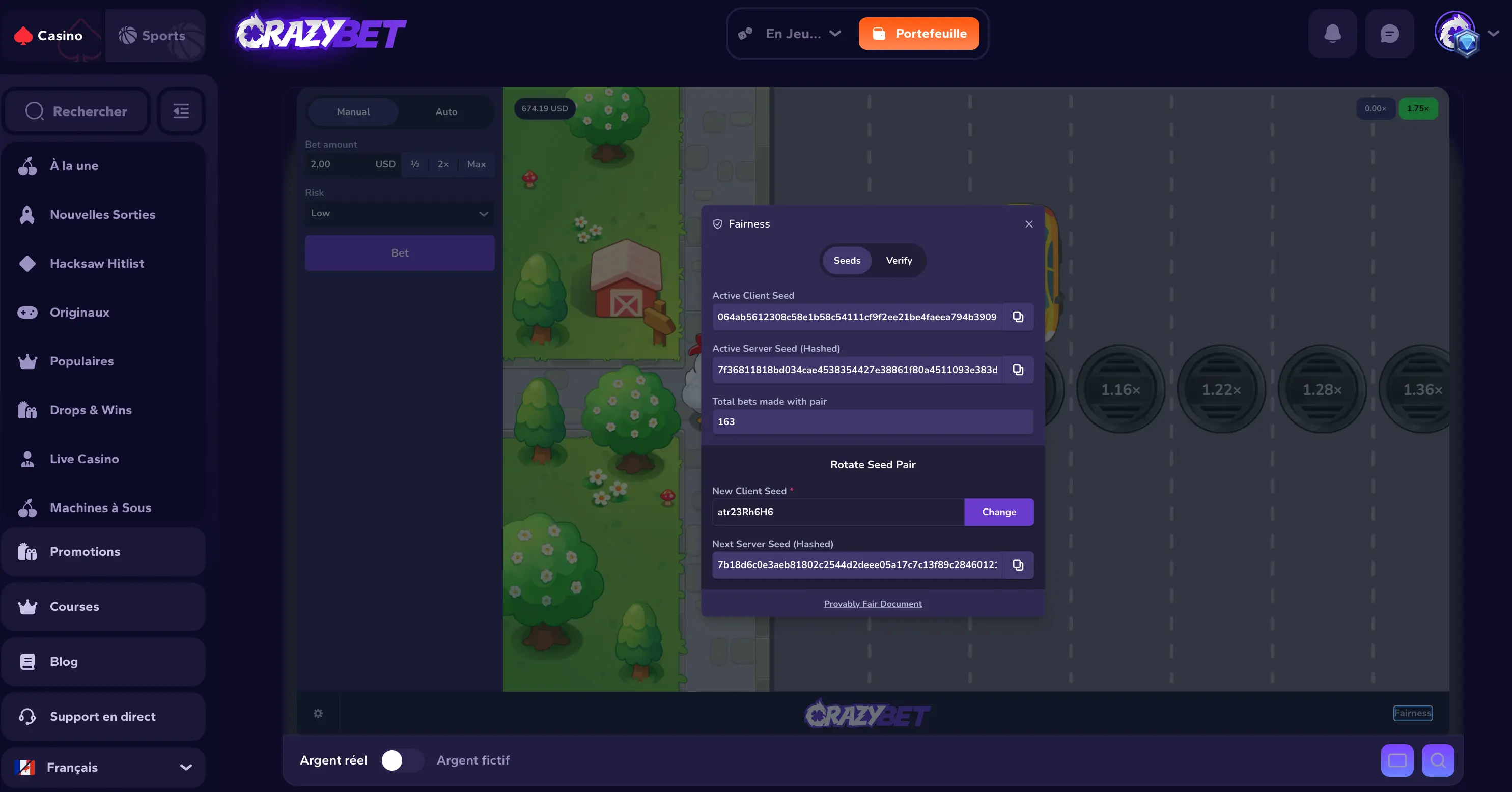
Because the Server Seed is locked before your session, it cannot be tampered with afterwards based on your decisions. You can change your Client Seed whenever you want through Rotate Seed Pair, and the Verify tab lets you recalculate a past result from the revealed seeds.
If the hash matches, the round was clean. The check takes two minutes, and it is the best answer to the “is it rigged?” question.
Our verdict on Chicken Road
Cross the Road deserves the hype. The concept is clean, fairness can be checked, the RTP sits amongst the most generous in the crash category, and the full control on every step makes it more engaging than Aviator, where you launch and hope. Its best feature is that it shows you the full road before you jump.
The flaw is not really in the game. It is in your head. The temptation to take one extra tile never leaves, and without discipline you hand your wins back.
Play it with a clear target. Lower the stake when you raise the risk, forget martingale, and remember that the extreme modes do not pay you less. They just pay you less often.